
How modern ideas in Quantum Physics are merging with the Mystery Tradition & Ancient Wisdom
[Note that this paper draws on the work of Quantum Physicist David Bohm: interested readers
can find details of a chat page on David Bohm below.]
The concept of the mind of man as viewed from themore dramatic of the psycho-physiologists, the concepts of the structureof the universe as viewed from the experimental edge of quantum physicsand the concepts of the Qabbalah and the Otz Chiíim as presented by thestudies of the SRIA, are beginning to merge. How close they are now toeach other is concealed partly by the differences in language and partlybecause each rarely looks closely at what the other is saying. In particular,of course, modern science hardly glances in the direction of the esoteric.I wish, for a few moments, tha we should look carefully in the other direction.
Psycho-physiology
Let us deal first with the mind or, more accurately,the memory. In the early part of this century it was assumed that memoryhad a specific location in the brain, as a book may have a specific locationon a library shelf, and some experimental evidence with eleptics seemedto bear this out.
A Californian Professor called Lashley tried to establish the locationof memory by experimentation. He taught rats to run through a maze fortheir food, then cut out different parts of their brains. He found theystill remembered how to run through the maze. No matter what part of theirbrains or even how much he removed, they remembered
all
thatthey had learned. A graduate student and then assistant, Karl Pribram,established with Lashley that there was, quite definitely, no no specificlocation in the brain for memory.
Pribram went on to become a professor and importantinnovative thinker. He noted that no patient ever came out of surgery,in which part of the brain was removed, with a selective memory loss. Nohead injury victim who suffered brain damage ever forgot half of his familyor half of a novel he had read.
Pribram was at a complete loss to understand this until, in 1956, heread and article about the first holographic picture. In a flash he understood.To understands what he understood, we need to go into brief detail abouta hologram.
A Hologram and how it is made.
Before you look at the diagram I want you to visualise something with me. Close your eyes and imagine that you are standing besidea pool of absolutely still water. You are holding one pebble in your left hand and two pebbles in your left hand - the other way round if you want, it doesnít matter. Toss one of the two pebbles in the water and visualise the splash. See in particular the waves rippling out in concentric circles from the point where the pebble entered the water. Imagine the water still completely still again. Now toss the two remaining pebbles into the water simulaneously, so that they land a little way apart. Note that there are two sets of concentric waves spreading out to eventuall cross, forming as they do an intricate pattern of crests and troughs of wavelets. The scientific term for the crossing of waves is ëinterferenceí. When I use the term ëinterferenceí in a moment I shall be using it with this precise and specific meaning.
Interfence, with this precise scientific, occurs when waves of anything converge. We do not normally notice interference in light waves, but a hologram uses a laser, where a beam is intensified and directed, and interference is measurable.Now look at the diagram below.A laser shines directly towards a photographic plate. However, between the laser and the plate is a beam splitter. Most readers will have noticed the mirror effect of a partially silvered window, in a toilet attendentís window, for example, enabling a watch to kept through the window, against vandalism or loitering. At the same time, it still functions as a mirror. A beam splitter in the production of a hologram works ion much the same principle. Part of the beams continues in a straight line and falls on the photographic plate. The other part of the beam is mirrored at 90 degrees, bounced subject of the hologram and is reflected onto the plate. The resulting pattern of interference is photographed. By shining a laser onto the negative at exactly the same angle as the original laser, a 3D image of the subject is produced and, as the viewer walks around it, the angles of what is seen change with the viewer. The appearance of somthing real is produced.
There are several properties of a hologram which are not immediatelyobvious and which were unknown to me a year ago. I suspect that many ofyou may not be aware of them either.
The Problems of Quantum Physics
Quantum Physics challenges established scientificideas. The most significant challenge involes the fact that sub-atomicpartices sometimes bahave as waves and not as separate entities at all,hence the name quanta for these things which are sometimes no thing .Evidence tends to suggest that observimg these quanta causes them to changetheir behaviour. Moreover, John Paternoster observes that he always arguedthat, in terms of quanta, a particle is a cross section through a ëwaveí- that they are the same in space but differentiated by time .As an analogy, imagine yourself at a bowling alley, about to roll a ball.You sprinkle the alley with talcum powder, so that the ball leaves a track,then you roll the ball. While you watch the ball it is a ball and leavesa trail where it rolls through the talcum powder. When you blink or otherwisestop watching the ball for a moment, the trail becomes the zig-zag patternof a wave. As soon as you start watching the ball again, it is a ball,leaving a single trail. Continuing the analogy, you place a sheet of plywoodacross the alley, with two ball sized holes in it. Attached to each holethere is an alarm, that lights up or rings a bell when a ball passes through.You roll one ball and both bells ring simultaneously.
A less striking problem, but more important to thispaper is that, under specific circumstances, two electrons, moving apartat the speed of light, behave as if they are in touch. If Einsteins formulafor the Genaral Theory of Relativity is correct, then they canít be intouch, because nothing can move faster than light. Bohm suggests a veryfar reaching alternative solution, and it underlies something very important.
Imagine you have an aquarium tank with one fish init and two TV cameras recording its movements from two different angles- one at the side of the tank, the other at the end - and two separatemonitors in another room. It will appear from the two monitors that youare watching two different fish, apparantly in contact and communicatingand moving together. Only in the context of the aquarium can they be understoodas one fish.

Just as the two fish are one in the context of the aquarium, Bohm suggeststhat the two particles are one wave at a higher level.
WHOLENESS AND THE IMPLICATE ORDER
I have struggled with the book by David Bohm setting out his ideas (andI do mean struggled) and have read a more accessible introduction to hiswork.Bohm urges the replacement of the current
paradigm
, on whichscientific experiment and argument are based, with something more easilychanged. He suggests that we need a conditional world view he calls an
insight
.This would be seen as a sort of temporary world vierw that can be changed
more readily when it is overtaken by experimental results which donítfit. This, he argues, is not the case with the current paradigm, whichscientists spend much time defending and causes them to question experimentalresults or summarily reject ideas which do not fit the paradigm. proposes,as a general new insight an
Undivided Wholeness
:
The new form of insight can perhaps best be called
Undivided Wholenessin Flowing Movement
. This view implies that
flow is, in some sense, prior to that of the things that can be seen toform and dissolve in this flow. This flux of aware-
ness is not precisely definable, and yet is evidently prior to the definableformsof thoughts and ideas which can be seen
to form and dissolve in the flux,like ripples, waves and vortices in aflowing stream. As happens with such patterns of
movement in a stream, some thoughts recur and persist in a more orlessstable way, while others are evanescent. The
proposal for a new general form of insight is that all matter is of thisnature:that is, there is a universal flux that cannot
be defined explicitly but canonly be known implicitly, as explicitly definableforms and shapes, some stable and some
unstable, that can be abstracted from the universal flux. In this flow,mind and matter are not separate substances.
Rather they are different aspectsof one whole and unbroken movement.
1
Contrast this with the ideas set out by Dion Fortunein her book Cosmic Doctrine . She talks of vortices and swirling in different language, and it is clear that she does not use the expression atom in a current scientific sense. There are, however, close parallels betweenthe stream of consiousness refeerred to by Bohm and the explanation givenon pages 36 &37 (SIL Trading edition, 1995) Remember that both aretrying explain the inexplicable and that Dion Fortune was trying to explainit (or her sources were) in terms of a pre-Einstein understanding of physics.
Bohm thinks that there is no question that thought(which he sees as a movement towards becoming, involving the relation ofdata to memory) is distinct from intellegence. Moreover, he is clear thatthe latter not only is not but could not be contained withinthe purely mechanistic functions of the brain. He says:
There is a great deal of evidence indicating that thought is basicallya material process. For example, it has been observed
in a wide variety of contextsthat thought is inseperable from the electricaland chemical activity in the brain and nervous
system ... Would one say that intellegence is a similar process,thoughperhaps more subtle?
It is implied in the view that we are suggesting here that this is notso. Ifintellegence to be an unconsitioned act of per-
ception, its ground cannot be instructures such as cells, molecules, atoms,elementary particles etc. Ultimately, anything
that is determined by the laws of such structures must be in thefield ofwhat can be known, i.e. stored up in memory ... The
actual operation of intellegence is thus beyond the possibility of beingdetermined or conditioned in any knowable law. So,
we see that the ground of intellegencemust be in the undetermined and unknownflux, that is also the ground of all definable
forms of matter.
2
I would ask you to dwell for a moment on this statement.What this Professor of Theoretical Physics - a quantum scientist - is sayingis what the Western Mystery Tradition has always maintened: that intellegenceresides in an imperishable part of us which is a part of whole of the creativeforce underlying the universe (in relious terms, our souls) and not partof mortal bodies. Bohm is just one of a growing number of quantum scientistswho are starting to think along these lines. Fritjof Capra has said:
Quantum theory thus reveals the basic oneness of the universe. It showshat we cannot decompose the world into independent-
ly existingsmallest units. As we penetrate into matter, nature does notshow us anyisolated basic building blocks but rather
a complicated set of relationsbetween the quantum particles.These relationsalways include the observer in an essential way.
3
Bohmís insistence that the mind and perceptions arepart of continuum with all things has some esoteric implications. I amnot sure that SRIA looks for scientific evidence to support the contentionsof ancient wisdom, of alchemical allergory of what Alestair Crowley calledmagick with a K, but the evidence is there.
You will possibly recall the childrenís game in whicha subject - even a willing adult - sits in a chair and four individualstry to lift her or him with ome finger each, placed behind the knees andunder the armpits. They find it impossible and each uses one hand to pressdown on the subjectís head for a full. They then use one finger each againand are quite able to raise the subject. Clearly the subject has not changedin essence. What has changed is the four peopleís perception of the subject.Bohmís work suggests that, since a continuum exists between the subjectand the experimenters, changing the perspective of the participants maychange the hologram (or at least their view of it, even though the realityis unchanged at the implicate level.
The Roman Catholic Church makes the distinction betweenthe ësubstanceí of the Bread and Wine at the Mass - what it is - and theëaccidentsí - what it appears to be. It is a distinction not popular withProtestants of a fundamentalist bent, but Bohmís line of reasoning is suggestive.If it is possible to modify the ëaccidentsí without changing the ësubstanceí- and the example quoted, indeed the whole chain of thought, points thatway - there can be no why it is not possible to change the substance withoutchanging the accidents, as the Church has traditionally claimed to be thecase. Bear in mind that Bohmís theory suggests, experimental evidence hintsand occult teaching insists, that the former is true.
Aleister Crowley says that:
Magic is the art and science of causing change in accordance with thewill 4
If he is right and such changes are possible, thenProfessor Bohmís argument that the mind is part of the same continuum aseverything else (in creation, though he does no quite say that), even thingslike rocks, which are generally assumed to have no conciousness, suggeststhat the way in which we perceive their accidents can indeed change them.
This would explain why telepathy, distant viewing,divining, psycho-kinetics and a hundred other psychic phenomena are real.It would also explain why the saint, the guru and the true adept are ableto change the world and produce what appear to be miracles.
Bohm makes the point that he is not calling fora new paradigm, but something less permanent: a ëstatement of how thingsappear to be on the basis of present knowledge that he calls an insight.On this basis it is much easier to compare Qabbalistic ideas with his ImplicateOrder, or concept of the Universe as a Hologram, since the Otz Chi im goesinto considerable detail not included in Bohmís insight. The importanceis that, despite differences of language, nothing in Bohmís insight contradictsoutright Qabbalistic teaching, the latter simply covers in detail areasnot covered by his thinking.
It is worth considering the implications of the emeraldtablet (whatever the origins, it undoubtably sums up traditional westernesoteric thinking):
Verum est ... quod superius est sicut quod infernius et quod inferniusestsicut quod superius, ad perpetrando miracula rei inius.
(The truth is that what is above is like to what is below and what is belowislike to what is above, to accomplish the miracles
of the one thing)
The significance to things occult is obvious - asDavid Conway remarks: The miracles of magick are governed by thisprinciple, although far from being miraculous, they are merely the resultsof applying certain natural though occult laws . 5
The Qabbalistic theory of creation holds that anawareness of the All flows (or flashes like a lightning streak) througha series of developing stages, becoming more substantial and ever closerto the material world, until it reaches full manifestation. The whole ofcreation is,
therefore, composed of essentially the same self-awareness of God.This is precisely what David Bohm is saying though, of course, he doesnot actually mention either God or Creation.
In terms of the Otz Chi im - and I say this onlyallegorically at this point - the pure, brilliant white light of Ketheris the ëlaserí, falling through Chochmah and Binah, which provide the beamsfor two holograms. The neams are split at Geburah and Chesed, part of eachbeam falling on both aspects of a balanced image in Tiphareth. The beamsfall on two negatives at Hod and Netzach and the two negatives are reflectedto Yesod, where the pure white light falling down the middle pillar projectsthe two realities - space and time - to Malkuth. We see a ëcreated realityífrom Malkuth, but time and space are no more than illusions. In the deeperreality of Yesod, we can only see the interference patters underlying thehologram.
Before you study the diagram below, I need to makethree points:
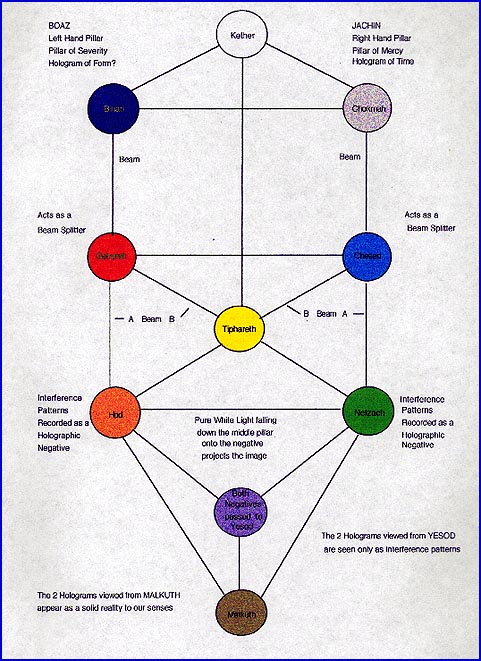
As a final thought, if I can be allowed a smirk, there is oe moreimplication. While it is possible that the mystery tradition representsno more than insights into the nature of reality, developed in the farpast by our ancestors who lived a different kind of life, it does havean alternative explanation. It could imply that the ëancient wisdomí westudy was created by individuals with the kind of scientific knowledgethat suggests long development - perhaps, as I suggested in a paper lastyear, in an earlier civilisation, now lost.
NOTES
BIBLIOGRAPHY
Bohn, David; Wholeness and the Implicate Order; London, Routledge& Kegan Paul; 1980
Capra, Fritjof; The Tao of Physics; London, Wildwood House; 1975
Conway, David; Magic: An Occult Primer; London, Jonathon Cape;1972
Crowley, Aleister; Magick in Theory and Practice; Secaucus N.J.,Castle Books; 1991
Fortune, Dion; Cosmic Doctrine; London, SIL Trading; 1995
Talbot, Michael; The Holographic Universe; London, Harper-Collins; 1996
David Bohm chat page - click this link: < http://thinkg.net/TT >
|
|
|
|
|
Return to Top of Page
|