 The idea is to:
This paper was delivered to Metropolitan College in June 1998 and to Michael Penrose College a month later. An edited version appeared in the journal of the Ordre Martiniste S.I., Autumn Equinox 1998 edition. Since the original version is quite short I have used that here. Members of the SRIA would do well to recall the remarks of the Senior Substitute Magus, Andrew Stevenson, after I had finished the Metropolitan College delivery, to the effect that overlooking is a very dubious practice with unforseen (and unforseeable) results. He was most specific in advising against it. Additionally, he recounted to me an anecdote from his own experience, reinforcing his point.
For millenniamen have been inventing steadily more complex machines to make life easierfor themselves, but only now, in the late 20th century, have we turnedto exploration of the mind and the development of 'mind machine'. New Agedevelopments have taken this from something clearly scientific in the 19thand 20th century sense of the term, into totally new directions ... orare they really so new?
'Psionics' iseasier to define than 'Techno-Shaman', but it is just as hard, or evenharder to pin down exactly what it is. 'Psionics' is the science of mindmachines, but what is a mind machine, in the sense of a psionicdevice?
I have a 'mind lab': a device which uses a variable speed beeping sound and a synchronised flashing strobe, designed to adjust brain waves to a pre-determined level, in order to achieve mental effects such as relaxation, visualisation and self hypnosis. Established psychology agrees that brain waves do readily follow such stimuli and experimental proof of telepathy includes the transmission of patters induced in this way from a sener to a receiver in another building and tracing the results on an EEG. My mind lab is, without doubt, a working mind machine. It is equally certainly not psionic, at least as the term is usually used.
Another scientificallyunderstandable and readily available electronic mind machine is the oneintended to develop lucid dreams. (a 'lucid dream' is one in which thedreamer knows that s/he is dreaming.) While the subject sleeps, a scannerlooks for rapid eye movements - a reliable sign of dream activity - and,when they occur, a strobe breaks into the consciousness of the user withoutwaking him/her. Variations are marketed by a couple of different importersand at least two small UK companies manufacture and sell them. Now thedevice does work ... at least it works electronically - you'd have to aska serious user whether it actually develops lucid dreaming. Again, however,I doubt whether one could call this a psionic device.
We areall, I think, accustomed to the idea of dowsing rods and pendulums. Theyapproach closer to what is meant by 'psionic' and one might even call themthat. However, the function of a pendulum or rods is to access informationalready in (or at least available to) one's inner mind, and I wonder whetherthis is true of every case of those instruments and machines commonly calledpsionic. Possibly it is.
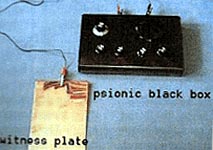
As an example of what is really meant by psionics, consider the 'psionic black box' (so called because the prototypes were cased in black plastic boxes - the colour may be immaterial, except that 'black box' hints at mystery and power, and that may in itself be significant.) The electronic circuitary of most does not make any sense scientifically. There is usually no power source and often not even a complete circuit. It constists of a flat copper plate about 8 or 10 cm square (called a 'witness plate') connected by a wire to the box. There is also a copper headband with button magnets, likewise attached by a wire. The box itself has a number of dials and knobs, usually about four, and a rubber or plastic 'thumb pad'.
The idea is to:
Now, what partdoes anything scientific play in all this? The answer is, I suggest, 'notmuch'! Appearance seems more important - it should look as if it works:for an individual of the late 20th or early 21st century, science, electroniccircuitary. knobs and dials, all serve the same function as special robes,the right colours, music, gems and incense play for the adept.
One of my sons is building a psionic back box with a more complete circuitary, using crystal diodes, like a crystal radio set, and variable capacitors - whether it works any better remains to be seen. Amongst the bigger names in psionics is Charles W. Cosimano. Searching 'psionics' on the Internet one runs across his name repeatedly. He wrote a specialised book called 'T he Psionic Magician's Gadget Pattern Book" in which maintained that the circuitary is totally unimportant. He suggested cutting Patterns from cardboard and covering the card with aluminium cooking foil. Cosimano insisted that everything (except the magnets on the headband) were just props, though the same proceedure had to be followed in use as if the device 'worked' (in scientific terms.) You will probably see a parellel here with magical working, where the whole of an operation can be carried out inside the head of an adept, visualising each step of the ritual.
The book Psychic Warrior by David Morehouse describes experiments in psychic distant viewing run,he claims by the US Military and in which he was personally involved. Thebook appeared on one of the book club lists in the UK last year and thereader might be forgiven for thinking it fiction, but for a CIA Press Releaseof September 1995, admitting that such experiments took place. The Septemberrelease played down the importance of such tests, but one dated December1995 came from one of the remote viewers and gave rather more detail. Thislater press release makes it clear that:
(a) Such experiments were successful to an un expectedly high degree and;
(b) The ability is latent in most people, and;
(c) Most people can be trained to develop it.
This technique was said in the December 1995 Press Statement to be 'psychotronic' and that the word is of Russian origin. Apparantly, psychic research spending by the Soviets rose year on year throughout the late 1960s and the 1970s, to the extent that CIA realised that the Soviets were getting results. This was, don't forget, the height of the Cold War and the CIA was worried. American research was first into what the Russians were studying - Western Science was so sceptical about psi abilities that the CIA was too sheepish to indulge in original research itself.
However, Soviet spendingon psi skills rose from 60 million roubles in 1970 to 300 million roublesby 1975 and the CIA began to panic. They concluded that Russians must begetting results to invest such large sums, and they seem to have fearedridicule less than the prospect of being left behind. They initiated theirown programme ... David Morehouse was involved in this work.
The book Mind Trek is by Joseph McMoneagle, who was the US military's foremost 'Remote Viewer'from the mid-1970s to his retirement in the the late 1980s to continuehis experimental work and to found an enterprise remote viewing commercially.A 1980s edition of the book described his participation in the StanfordResearch Institute experimental programme and how he learnt to do remoteviewing. After the CIA programme ended, the book was revised and described(as far as was possible without giving away official secrets) the CIA programmeand his part in it. One of the more interesting claims he makes is thatmost of the elusive Scud missiles hit during the Gulf War were found byremote viewers, not satellite observations. The book does, incidentally,indicate a training methodology.
McMoneagle tries to distance himself from anything occult, to make his experiences 'scientific' and to introduce a whole new vocabulary to his work - but you would see some very traditional ideas behind his words. A major theme in a paper of mine to Metropolitan Study Group last year was that science (or at least the leading edge of it) is now saying much the same as Rosicrucians and others on the path of the Western Mysteries have always said about reality and related issues. I suggest that much of psionics involves re-inventing the wheel for the new century and giving it a new name for the new millenium. Psionics and psychotronics appear to be describing different aspects of the same thing. At the risk of upsetting techno-shamans, the CIA, the US military and Joseph McMoneagle, all appear to cover the same ground as the adept does in the practice of magick!
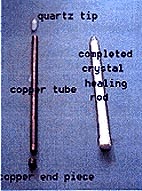 Another major tool in the psionic tool kit is the crystal healing rod. You take a length of copper piping about 30 cm long, cap one end, stick a quartz crystal in the other end, then wind a thin strip of leather round it to insulate it, decorating to taste. This is the basic psionic tool. Its builders and proponants claim variously that it was widely used in Atlantis and that it is a psionic particle accelerator. The rod is aimed at the place where healing is needed and the user visualises a beam of white light projecting from it. The argument is that the 'machine' is operated by the mind of the operator.
A techno-Shaman uses psionictools, but functions in traditional shamanic ways. If one is to take suchwriters as Carlos Castanada seriously, some of the present day shamansuse mind-altering drugs, as shamans have traditionally done. Generallythose used are the naturally occurring ones, like the seed 'buttons' ofthe peyote cactus or 'magic mushrooms', but the couple of people I knowwho use a shamanic approach appear to do so without resort to drugs atall.
There is an overlap between Psionics and New Age 'religion', but the borders are blurred. Some of the UFO interest groups use psionic devices, but I find it difficult to take the written explanations of their interest seriously, at least not as they interpret the phenomena. In general they have no point of contact with New Age Shaman, who might well use crystals generally and the healing rod in particular, channeling, drumming, dance, meditation and one of the New Age Tarots or similar divinatory systems, like runes.
For many on the traditional path, the ritual robes, the Waite-Rider, Golden Dawn, BOTA or Hanson-Roberts Tarot Decks and the right incense, the right images and guardians on the right path to the correct Sephira with the appropriate God-Form ... these are the kind of correspondences which tune the mind in to the objective, whatever that might be. I can make some psionic tools work, but I tend naturally towards the established path of the Western Mystery Tradition. For many others, brought up in the shiny world of technology and computers, the need is for the electronic gadgetry of the world they know, rather than what they see as medieava superstition. Maybe it will work for them - the evidence of psychotronics and the Stanford Research Institute and the CIA programme appears entirely positive.
NOTES:
There are no direct quotes, but I have drawn from the followuing:
Crystal Warrior; Michael G. Smith & Lyn Westhrop; LlewellynPublications, St. Paul, Minn; 1992
Mind Trek - Exploring Consciousness, Time and Space Through RemoteViewing; Joseph McMoneagle; Hampton Roads Publishing, Virginia; 1997
Press Release of Ingo Swann; 1 December 1995 (available on theInternet)
Psionic Magician's Gadget Pattern Book; Charles W. Cosimano;International Guild of Advanced Sciences; California; 1994
Psychic Warrior; David Morehouse; Michael Joseph, London; 1996
AFTERWORD
An internet search engine like Alta Vista turns up 450+ entries underpsionics, though not all are relevant. Ingo Swann's website is
http://www.biomindsuperpowers.com
There is also a site devoted to Controlled Remote Viewing, but I can'trecall the details off hand. Try a search?
|
|
|
|
|
Back to the Top
|
|
|